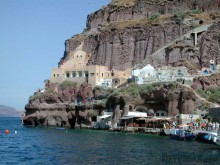
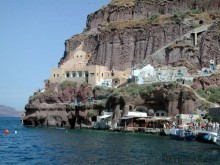
This early 20th century complex, an old tomato factory, is located at the south end of the Old Harbour, and dominates the area. Its location is promoting the restoration and reuse of the building due to increased tourist interest and its spectacular view available mainly from the roof.
Structure building: The complex is a stone bearing construction with impressive domes and vaults that are visible from inside the building.
Structure spaces: The complex occupies an area of 1,700m ² and consists of two floors (of 5m height) with independent accesses, which in turn can accommodate separate uses.
The interiors of the factory cover a total area of 700m² (350m² per floor) and the adjacent buildings 300m². The complex is complemented by 200m² outdoor and semi-open spaces and terraces of 400².
Visitors: Customers in the multiplex will be mostly passengers from cruise ships arriving in the port, the volcano trippers and locals or tourists who will visit the Old Port for a ride. Guests of 2003, according to the Port Authority were 379.000 cruise passengers and 20.000 tourists descended by cable car to visit the volcano, so potential customers of the complex amounting to 400.000 per year without counting the local consumers.
Future upgrade: The launch of the multiplex determined at spring of 2005 and coincided with the completion of the redevelopment of the entire harbour, which includes the creation of a small marina for yachts of "sea tourists" who are currently not served.
Location
Santorini is perhaps the most fascinating and most talked about island of Greece in the Aegean. Only the name of the island is enough to unfold in mind pleasurable connotations, volcanic landscape, gray and red beaches, dazzling white houses, terraces with panoramic sea views , stunning sunsets, wild fun.
All this, together with remnants of lost civilizations discovered in the volcanic ash justify the epithets with which visitors identify Santorini and fairly is called, magical, indescribable, astonishing.
The volcano is still active, and the last eruption was in 1950, causing an earthquake that destroyed many villages on the island. The island's official name is Thira and its main town, Fira, is also the capital of the Cyclades islands. It is a cosmopolitan island and is therefore quite expensive.
The locals live mainly off agriculture and tourism. The islands largest export product is soil; 2.000.000 tons a year are used all over the world, mainly to make concrete. The Suez channel was built with this concrete for example.
Most holidaymakers stay where the beaches are, Kamari and Perissa, but these places really do not represent the island's amazing distinctiveness.
If you can, you should try to stay in Fira, Imerovigli or Oia, the towns on the cliffs, which are very beautiful and full of little cafes, shops and places of interest. There is a bus that goes to the beaches every day, and it is much better to be in the towns in the evening and on the beaches during the day. If you stay in Monolithos you will have more peace and quiet.
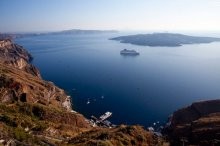
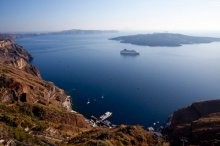
Approaching the island by boat the immediate impression obtained is this is a Greek island unlike any other. The island of Santorini was formed out of the lava from the volcanic eruption in 1660 BC. The central part of the volcano sank into the sea leading to the emergence of Santorini itself and the tiny neighboring islands of Thirasia, Palaia and Nea Kameni close by.
Today, Santorini is the only inhabited Caldera (volcano cauldron) in the world. Unlike other islands in Greece, the towns and villages sit densely on top of the massive cliffs of the Caldera and from a distance appear like snow capping the towering mountain tops. The coloured strata of the volcanic rock of these cliffs are spectacular in themselves: chocolate brown, rust red, yellow ochre, white and cream.
The geological uniqueness however is not the only thing that makes Santorini a special holiday destination.
Everyone has read about the spectacular sunsets that occur on this island and the sceptic may question whether the setting sun can really appear differently here than from the neighbouring islands of Naxos or Ios. Nevertheless, the sunsets at Santorini, viewed from the Caldera, really are breathtakingly beautiful when seen as a backdrop to the volcano. The colours that streak the sky change from lilac to deep purple, from yellow to orange to red, as the golden sun sinks and becomes blood red reflecting its light on to the sea and the surrounding little islands, an amazing scene for photography. The eastern slopes of the island are green and fertile, even in October. This is due to the copious vineyards that grow so well in the fertile volcanic soil. The terraced slopes of the mountains use every available part of this fertile land. The island suffer from water scarcity, because it has few natural water reserves, but the nature of the dry soil of Santorini produces grapes that make up one of the best wines of Greece. The climate, though damp is healthy and perfect for producing the famous wine (vinsando), fava beans and tomatoes. There are many wineries and a a local factory for canning tomato paste, tomatoes and vegetables. Santorini used to export a lot of pumice that finally stopped due to the destruction the old pumice mines did to the island. The old mines now are used for the burial of waste.
Today the island's economy relies on tourism, where tens of thousands tourists from Greece and around the world visit the island for unforgettable holidays
History
Santorini used to be a round island, but during an earthquake and volcano-outbreak in the 15th century BC the middle of the island sunk and gave it the shape it has today. The underwater volcano, which is one of the rare examples of volcanoes in the world created from a circular island that was there before the explosion, a group of islands namely Thera, Thirassia, New and Old Kameni and Aspronisi. This is one of the reasons why many believe Santorini really is where Atlantis once was. The Minoan civilization on the island was razed after this, but apparently, most people managed to flee.
The island has changed names through history. Originally it was called Stroggyli ("round") since that was the shape of the island. When the Phoenicians came they named it Kallisti ("the very best"), and finally it got the name Thira after its first ruler.
There was the son of the Theban hero Autesion who was a descendant of Cadmus. He was the vice king of Sparta and responsible for his twin nephews Procles and Eurysthenes. When they were old enough to rule by themselves, Theras left Sparta with a company of aristocrats and settled on Santorini.
The Romans originally used the island as a place for exiles, but later helped in building up the island. The Christianization of Santorini took place between the 2nd and 5th century. The island was often ravaged and even destroyed by pirates and in 1204 it was conquered by the Venetians. It was about then the island got its current name. The islands patron saint was Agia Irini (St Eirene) and the foreign sailors called her St Irini - thus Santorini.
The island was destroyed by the Venetians in 1354, and once again in 1397, this time by the conquering Turks. In 1821 Santorini joined forces with the Greek revolutionists and the island was subsequently freed from Turkish rule. In 1956 there was a terrible earthquake which caused many buildings to be ruined. The people in Kamari are almost all from a village that was totally destroyed back then.
The island has been reconstructed after the terrible earthquake that destroyed it on 9 July 1956.
Old Port
The contact of Fira to the sea (Bay of Fira) to satisfy commercial and tourism needs today is either the path - stairs or the lift. This area includes the port (fishing facilities), commercial (shops) and entertainment (coffee, ouzo).
This small harbour and its bay offer the possibility to take a quick swim (if the sea and the wind are calm). Looking northwards, the bay displays its characteristic yellowish rocks and caves which structure is due to the sea erosion.
Once departed, notice the amazing face of the Caldera behind you and its white hat, Fira, that dominates you; notice the sides of the island with its spectacular cave of and its arms that seem to hug you. After just 5 minutes sailing the sea has already reached a depth of 985 ft (it will be even deeper)
Why Greece?
* It has strict build density regulations, which will avoid major developments in future and thus overbuilding
* Only 3½ hours from London and many European cities making it a viable weekend break holiday destination
* Voted by the Lonely Planet Guide 2010 as one of the top 10 countries in the world to visit
Price (Euros) 2200000
Build area (m²) 700
By sea no
Levels 2
 Ford Focus Focus
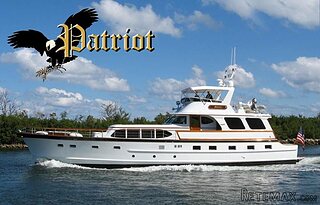 72' Burger 72 Cockpit Motoryacht 1961
 Wolverine A-14-22 Processor for sale..
 Internacionalni sajam pršuta u Tinjanu, 18..
 Rab, Mali Palit - građevinsko zemljište 2...
 Poljoprivredno zemljište, Istra, Kavran, 3..
 26' Glacier Bay 2690 Coastal Runner 2..
 31' Chris-Craft Commander 1969
 17' Boston Whaler 170 Dauntless 2020
 70' Scorpion 70 2008
 Zetor 4945
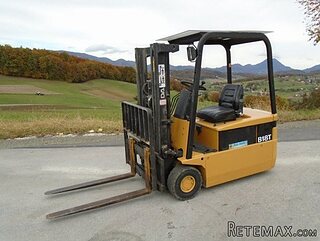 Vilicar daewoo b 18t
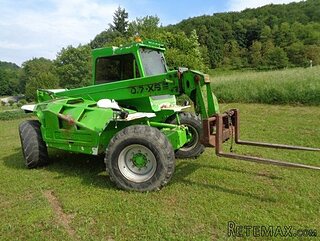 TELESKOPSKI VILIČAR MERLO 30.7-XS
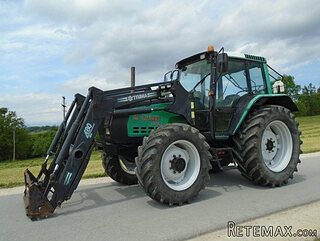 Valtra 6400